
In high-stakes biochemical research, a 99% purity rating isn't a target; it's the absolute baseline for experimental integrity and data reproducibility. You've likely faced the frustration of skewed data or irreproducible in-vitro results caused by trace contaminants. When utilizing 99 percent purity peptides, these microscopic impurities are eliminated, ensuring that your observations reflect the compound's actual biological activity rather than chemical noise.
It's critical to understand the technical specifications that separate premium research materials from substandard alternatives. This guide clarifies how to interpret complex HPLC reports and why local, third-party verified sourcing is essential under the Emirates Drug Establishment's evolving regulatory framework. We'll examine the chemical makeup of elite research materials, the necessity of mass spectrometry verification, and how to secure reliable, laboratory-grade peptides within the UAE to maintain your rigorous R&D standards.
Key Takeaways
- Define technical purity as the specific ratio of the target peptide sequence relative to unavoidable synthesis byproducts like deletion sequences.
- Identify the critical roles of HPLC and Mass Spectrometry as the mandatory methodologies for verifying both chemical purity and molecular identity.
- Understand how 99 percent purity peptides eliminate confounding variables to ensure data reproducibility in UAE-based laboratory environments.
- Navigate the local procurement landscape in Dubai and Abu Dhabi to secure research materials with verified third-party documentation and batch-specific transparency.
- Establish a rigorous baseline for institutional procurement that prioritizes technical verification and regional supply chain reliability.
What Does 99 Percent Purity Peptides Actually Mean?
In analytical biochemistry, purity is defined as the mass percentage of the target peptide sequence relative to the total peptide content. It's a specific measurement of molecular accuracy. When a laboratory utilizes 99 percent purity peptides, they're ensuring that 99% of the peptide molecules in the vial match the intended primary structure. The remaining 1% isn't "dirt" or external debris. Instead, it consists of closely related chemical variants created during the manufacturing process. Achieving 100% purity is a theoretical impossibility. Entropy and the limits of chromatography mean that even the most refined processes leave trace amounts of structural analogs.
Distinguishing between material grades is vital for UAE researchers. Most laboratory failures stem from using inferior grades that contain confounding variables. Materials generally fall into three categories:
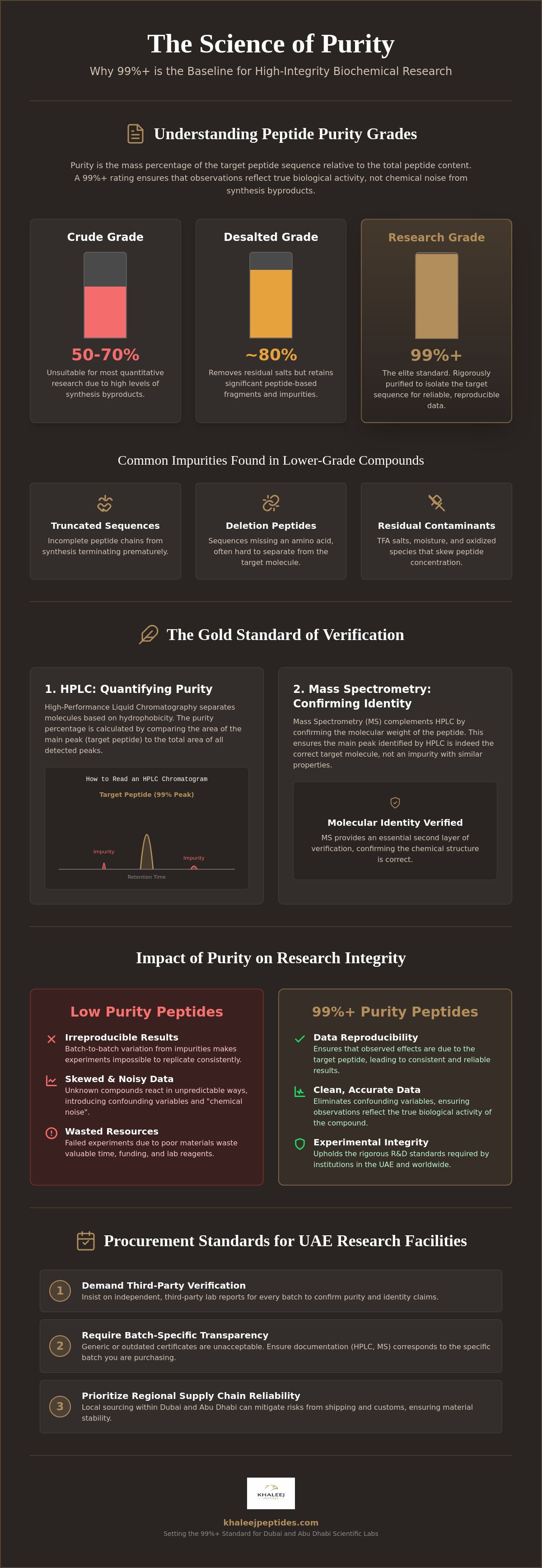
- Crude Grade: Often 50% to 70% pure; contains all synthesis byproducts and is unsuitable for most quantitative research.
- Desalted Grade: Removes residual salts but retains significant peptide-based fragments.
- Research Grade (99%+): Subjected to rigorous purification to isolate the target sequence, representing the elite standard for Dubai and Abu Dhabi labs.
Solid-Phase Peptide Synthesis (SPPS) and Error Rates
Solid-Phase Peptide Synthesis (SPPS) is the industry standard for high-purity synthesis. This technique involves the sequential addition of amino acids to a resin-bound substrate. During Peptide synthesis, each coupling cycle has an efficiency rate, typically above 99%. However, these small inefficiencies aggregate. As the chain grows longer, the probability of an error in the sequence increases. A peptide with 30 amino acids faces thirty opportunities for a coupling failure. Maintaining a 99% purity standard requires meticulous control over reaction conditions to minimize these cumulative defects.
Common Impurities Found in Lower-Grade Compounds
Impurities in research materials generally fall into three categories. Truncated sequences occur when the synthesis terminates early, leaving behind shorter, incomplete chains. Deletion peptides are more problematic; these are sequences missing a single amino acid from the center of the chain, often possessing similar physical properties to the target molecule. Finally, residual contaminants like TFA salts, moisture, and oxidized species can skew the effective concentration of the peptide. In UAE laboratories, these contaminants can lead to irreproducible results or unexpected toxicity in cellular models. High-purity standards ensure these variables don't compromise your R&D objectives.
Verification Methodologies: HPLC and Mass Spectrometry
High-Performance Liquid Chromatography (HPLC) serves as the primary quantitative tool for assessing chemical purity. While the synthesis process creates the compound, chromatography validates the result. UAE research institutions require rigorous Verification Methodologies: HPLC and Mass Spectrometry to ensure that 99 percent purity peptides meet the documented specifications before introduction into in-vitro models. Verification isn't a formality. It's the only way to safeguard your data against chemical interference.
The HPLC process relies on the differential migration of molecules through a stationary phase. A mobile phase, typically a gradient of acetonitrile and water, carries the sample through a packed column. Peptides interact with the column material based on hydrophobicity. Impurities, such as deletion sequences or residual solvents, exit the column at different intervals. The detector records these events as peaks on a chromatogram. The purity percentage is calculated by integrating the area under the main peak and comparing it to the total area of all detected peaks. This ratio determines the final purity grade.
How to Read an HPLC Chromatogram
A standard report displays a large, dominant peak representing the target sequence. Its position on the horizontal axis is the retention time. Minor peaks appearing before or after indicate contaminants. High-resolution chromatography minimizes baseline noise, which can otherwise mask small impurities. Researchers must look for a clean baseline and a sharp, symmetrical main peak. If the main peak shows shoulders or splitting, it suggests co-eluting impurities that compromise the 99% standard. Khaleej Peptides provides batch-specific data to ensure every Tirzepatide Pen or vial meets these analytical benchmarks.
Mass Spectrometry: Confirming the Identity
Purity measurements only reveal how much of a substance is present in the vial. Mass Spectrometry (MS) identifies what that substance actually is. It measures the mass-to-charge (m/z) ratio of the ionized peptide. By comparing the observed molecular weight against the theoretical value derived from the amino acid sequence, labs confirm the identity of the compound. A 99% purity rating is scientifically meaningless if the peptide identity is incorrect. Matching the exact m/z ratio ensures that the synthesized material is structurally sound and free from significant amino acid substitutions. This dual-verification approach is mandatory for any laboratory operating in Dubai or Abu Dhabi that values experimental precision.
The Impact of Purity on UAE Laboratory Research Results
In the context of UAE laboratory protocols, the transition from theoretical purity to practical application is where experimental integrity is either maintained or lost. Utilizing 99 percent purity peptides is not a luxury. It is a prerequisite for high-fidelity data. Even a 1% margin of error can introduce structural analogs that mimic the target peptide's behavior. These analogs often compete for the same receptors. This creates chemical noise that obscures the true biological response. The Impact of Purity on Research Results is most evident when analyzing cellular signaling pathways where precision is paramount. Verification is not optional. It is the foundation of the scientific method.
Reproducibility is the benchmark of global scientific excellence. For labs in Dubai and Abu Dhabi, aligning results with international peer-reviewed standards requires materials that eliminate confounding variables. Residual Trifluoroacetic acid (TFA) is a frequent byproduct of the cleavage process during synthesis. While often ignored in lower-grade materials, TFA is cytotoxic. It can alter pH levels in cell culture media. This leads to cell death or altered morphology that researchers might incorrectly attribute to the peptide itself. High-purity standards ensure that observed effects are the result of the peptide sequence, not the contaminants.
Precision in dosing depends on knowing the exact mass of the active ingredient. Impurities add dead weight. This leads to overestimating the actual concentration of the peptide in solution. Such errors fundamentally invalidate molar-based comparisons across different studies. In UAE R&D facilities, where high-throughput screening is common, a minor variance in purity can lead to significant variances in observed potency due to non-linear biological responses.
In-Vitro Assay Sensitivity and Signal Interference
Metabolic research requires absolute specificity. Peptide byproducts can cause false positives by triggering secondary signaling cascades. In mitochondrial research, compounds like MOTS-C must be free of truncated sequences. Any variation in the C-terminus can entirely negate its metabolic signaling properties. Maintaining signal integrity requires a sterile, high-purity environment where the target molecule remains the sole active agent.
Potency and Long-Term Stability
Impurities often act as catalysts for further peptide degradation. High-purity materials exhibit superior shelf-life and structural integrity. 99% purity minimizes the risk of enzymatic cleavage during research. This level of refinement ensures that lyophilized powders remain stable during storage in regional facilities. It prevents the formation of aggregate species that can interfere with solubility and biological activity during reconstitution.
Procurement Standards for UAE Research Facilities
Procurement for UAE research facilities requires a departure from traditional international shipping models. Relying on cross-border logistics often introduces variables that compromise the structural integrity of synthetic compounds. High ambient temperatures in the region necessitate a supply chain that prioritizes thermal stability. When sourcing 99 percent purity peptides, the focus must remain on localized inventory and expedited, temperature-controlled transport. This ensures that the material arriving at a Dubai or Abu Dhabi laboratory remains identical to the batch verified at the point of synthesis.
Compliance with Federal Decree-Law No. 38 of 2024 is essential for institutional procurement. This legislation consolidates the regulation of medical and pharmaceutical products under the Emirates Drug Establishment (EDE). All materials must be explicitly labeled and utilized for in-vitro research use only. Maintaining clear documentation regarding the intended laboratory application protects the facility. It ensures alignment with national scientific mandates. Professional gatekeepers in the procurement office must verify that every compound is strictly for laboratory use to remain within the legal framework of the United Arab Emirates.
Selecting a Local UAE Supplier
Evaluating a supplier requires looking beyond the catalog. Local inventory in the UAE eliminates the unpredictable delays associated with international customs. For urgent metabolic research, having access to materials within 24 to 48 hours is a significant advantage. Local technical support provides a level of accountability that international providers cannot match. It allows for direct communication regarding batch-specific data and regional storage conditions. Selecting a partner with a refined regional focus ensures that the logistical chain is optimized for the local climate.
Verifying the Certificate of Analysis (COA)
A valid Certificate of Analysis is the primary document of trust. Every vial or pen must be accompanied by a COA that displays a batch number matching the physical product. UAE researchers should verify that the testing was conducted by an independent third-party laboratory. The report must include both the HPLC chromatogram for purity and the mass spectrometry data for identity. Ensure the testing date is recent. Older reports may not reflect the current state of the lyophilized powder. Researchers seeking verified materials can secure 99 percent purity peptides through Khaleej Peptides, ensuring every batch meets these rigorous standards.
Khaleej Peptides: 99%+ Standards for Dubai Scientific Labs
Khaleej Peptides operates as a specialized gatekeeper for the UAE scientific community. We maintain a rigorous minimum threshold of 99% purity across our entire inventory. This standard ensures that research conducted in Dubai and Abu Dhabi laboratories remains free from the chemical variables introduced by lower-grade synthesis. Every batch undergoes exhaustive independent third-party verification. This process includes both HPLC for purity quantification and mass spectrometry for structural identity confirmation. By providing 99 percent purity peptides, we enable researchers to focus on data acquisition rather than material validation.
Our distribution model is engineered for the specific requirements of the United Arab Emirates. Rapid, discreet delivery within the UAE minimizes the risks associated with international transit and customs interference. We utilize temperature-controlled logistics to preserve the structural integrity of lyophilized powders. This localized approach eliminates the unpredictable delays of global supply chains. It ensures that your laboratory receives materials that meet the highest global scientific benchmarks without the typical logistical friction found in cross-border procurement.
Product Range: From Metabolic to Regenerative Peptides
Our catalog addresses the diverse requirements of metabolic and regenerative research. We provide high-purity Retatrutide Pen and Tirzepatide Pen options for endocrine studies. These specialized delivery formats allow for precise, repeatable handling in a laboratory setting. For regenerative research, our inventory includes BPC-157 and the CJC-1295 No DAC + Ipamorelin Pen. Cellular energy studies are supported by laboratory-grade NAD+ and MOTS-C. These compounds are synthesized to ensure consistent results in mitochondrial and metabolic assays. Each product is delivered in vials or pens designed for optimal stability and ease of reconstitution.
The Khaleej Peptides Quality Assurance Protocol
The quality assurance protocol begins with internal synthesis standards that exceed basic industry requirements. We employ advanced post-production purification to reach the ≥99% benchmark consistently. We strictly adhere to Research Use Only (RUO) guidelines. This alignment with the Emirates Drug Establishment (EDE) ensures that all procurement remains within the legal framework for UAE-based R&D. Our commitment to transparency means that batch-specific data is always available to our institutional partners. We prioritize technical rigor over marketing fluff. This makes us a reliable partner for high-stakes scientific inquiry in the region.
Explore our 99% purity research catalog for UAE laboratories
Elevating UAE Research Standards Through Analytical Precision
Achieving reproducible data in high-stakes biochemical research depends entirely on the chemical integrity of your starting materials. By establishing 99 percent purity peptides as your laboratory baseline, you eliminate the confounding variables of synthesis byproducts and cytotoxic contaminants. We've explored the necessity of third-party HPLC verification and the critical role of mass spectrometry in confirming molecular identity within the UAE’s evolving regulatory landscape. These technical standards are the only way to ensure that your metabolic or regenerative assays match global scientific benchmarks.
Khaleej Peptides remains committed to supporting the region’s R&D community with materials that meet these rigorous specifications. Every batch is third-party HPLC verified and synthesized to a minimum 99% purity. Our localized distribution network ensures fast, temperature-controlled delivery across Dubai and Abu Dhabi, protecting your research from the degradation risks of international shipping. Precision is the ultimate driver of innovation. We're here to provide the verified tools necessary for your next breakthrough.
Secure High-Purity Research Peptides for Your UAE Laboratory
Frequently Asked Questions
Why is 99% purity considered the gold standard for research peptides?
99% purity is the industry benchmark because it minimizes chemical noise and ensures that biological responses are attributable solely to the target sequence. High-purity standards prevent structural analogs from competing for receptor sites, which is vital for maintaining the integrity of in-vitro assays. This level of refinement represents the upper limit of modern purification technology while remaining commercially viable for large-scale R&D.
Can I expect 100% purity when ordering research-grade peptides?
Absolute 100% purity is a theoretical impossibility in biochemistry due to the limits of chromatography and the nature of chemical entropy. Even the most advanced Solid-Phase Peptide Synthesis (SPPS) leaves trace structural analogs or residual moisture. High-grade research materials target a minimum of 99% to ensure that these unavoidable trace elements don't interfere with experimental outcomes.
How do impurities in peptides affect in-vitro experimental results?
Impurities introduce confounding variables that can lead to irreproducible data or false positives in cellular assays. Minor contaminants like deletion sequences can trigger unintended signaling pathways or block target receptors. In UAE labs, utilizing 99 percent purity peptides is essential to ensure that observed metabolic or regenerative effects aren't skewed by chemical debris or cytotoxic synthesis byproducts.
What is the difference between an HPLC report and a Mass Spec report?
An HPLC report quantifies the purity level, while a Mass Spectrometry (MS) report confirms the molecular identity. HPLC uses chromatography to separate the target peptide from impurities, calculating a percentage based on the area under the peak. Mass Spec measures the mass-to-charge ratio to verify that the synthesized molecule matches the intended amino acid sequence and theoretical molecular weight.
How should 99% pure peptides be stored to maintain their integrity in the UAE climate?
Lyophilized peptides must be stored in a temperature-controlled environment, ideally at -20°C for long-term stability or 4°C for short-term use. The UAE's high ambient humidity and heat necessitate airtight seals to prevent moisture absorption and thermal degradation. Once reconstituted, peptides are significantly more fragile and should be aliquoted and kept frozen to minimize freeze-thaw cycles that compromise structural integrity.
Are Khaleej Peptides' products tested by independent third parties?
Yes, all batches in our catalog undergo rigorous testing by independent third-party laboratories to ensure technical transparency. We provide batch-specific HPLC and Mass Spec data for every 99 percent purity peptides order. This verification process acts as a quality gatekeeper, ensuring that researchers in Dubai and Abu Dhabi receive materials that meet documented specifications before starting their trials.
What are the most common impurities found in synthetic peptides?
The most frequent impurities include truncated sequences, deletion peptides, and residual solvents like trifluoroacetic acid (TFA). Truncated sequences occur when synthesis terminates prematurely; deletion peptides are missing a specific amino acid within the chain. Other contaminants include oxidized species and residual salts, all of which can alter the peptide's effective concentration and biological activity during in-vitro research.
How long does delivery take for research peptides in Dubai and Abu Dhabi?
Delivery typically takes 24 to 48 hours for laboratory facilities located within Dubai and Abu Dhabi. We maintain local inventory to bypass the unpredictable delays associated with international shipping and customs. This rapid distribution model is critical for time-sensitive metabolic studies where maintaining a consistent supply chain of high-purity research materials is a priority for the facility.