The integrity of in-vitro data relies entirely on the chemical precision of the underlying compound. For scientists in Dubai and Abu Dhabi, securing BPC-157 research grade UAE materials often means balancing the need for immediate availability against the rigorous requirement for 99% or higher purity. You're likely familiar with the frustration of opaque Certificates of Analysis and the risk of peptide degradation during extended international shipping. Reliability in the laboratory isn't just about the molecule. It's about the verifiable data trail that accompanies every vial.
This article provides a technical analysis of BPC-157 synthesis, purity verification through High-Performance Liquid Chromatography (HPLC), and standardized laboratory handling protocols. We'll examine how to interpret third-party technical reports and establish proper reconstitution methods to ensure structural integrity even during UAE summer transit. By focusing on localized supply chains and stringent verification, researchers can eliminate the variables that often compromise sensitive laboratory outcomes.
Key Takeaways
- Understand why a 99% purity benchmark is the non-negotiable standard for maintaining the integrity of in-vitro regenerative data.
- Learn to evaluate HPLC verification and technical reports when sourcing BPC-157 research grade UAE to ensure batch-to-batch consistency.
- Identify the biochemical pathways, specifically the Nitric Oxide system and VEGF expression, relevant to laboratory models of angiogenesis.
- Master specific handling and storage protocols designed to mitigate thermal degradation risks inherent to the United Arab Emirates environment.
- Discover the logistical advantages of local procurement in Dubai and Abu Dhabi for preserving the structural integrity of lyophilized peptides.
Understanding BPC-157 Pentadecapeptide in Biochemical Research
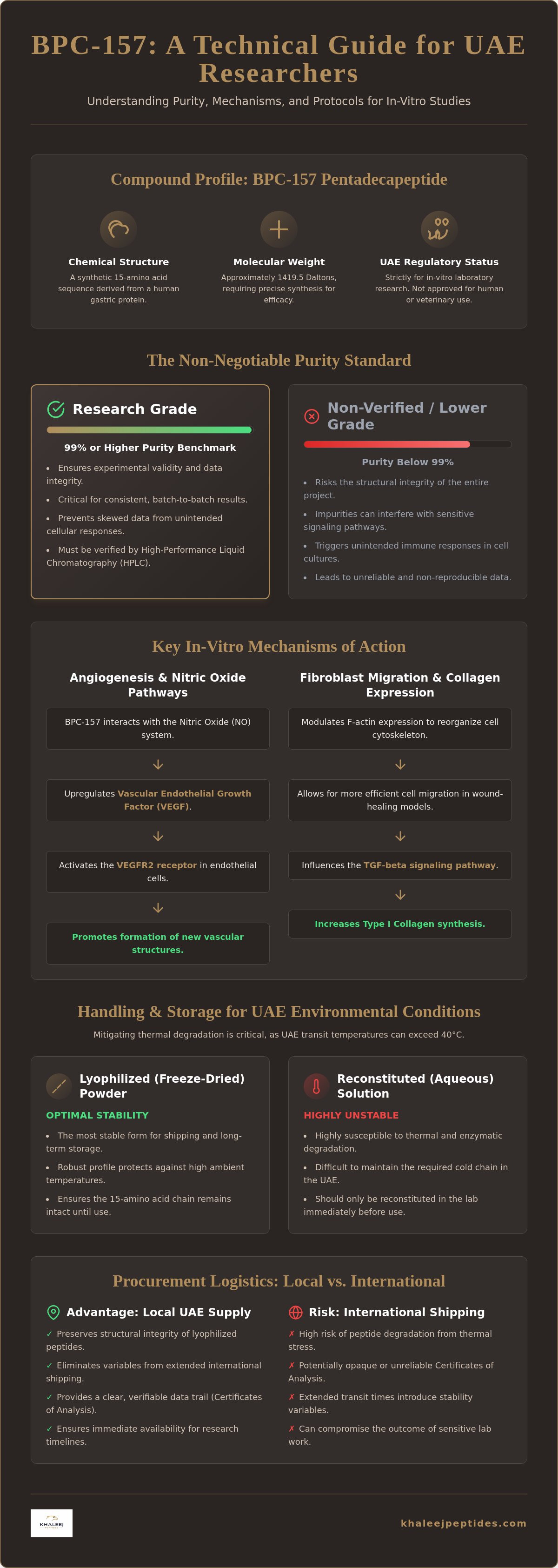
BPC-157 is a synthetic 15-amino acid sequence. It's frequently classified as a "Body Protective Compound" in biochemical literature. Within the United Arab Emirates, the regulatory framework specifies that this material is strictly for laboratory and in-vitro research. It's not approved for human or veterinary consumption. For investigators conducting regenerative studies, the chemical integrity of the compound is the primary determinant of experimental validity. Securing BPC-157 research grade UAE ensures that the molecular sequence remains stable under controlled conditions, preventing the introduction of variables that could skew cellular data.
Chemical Structure and Molecular Profile
The BPC-157 Pentadecapeptide sequence is L-Valyl-L-alanyl-L-leucyl-L-glycyl-L-prolyl-L-prolyl-L-prolyl-L-glycyl-L-lysyl-L-prolyl-L-alanyl-L-aspartyl-L-aspartyl-L-alanyl-glycine. This specific 1-15 amino acid chain must be synthesized with absolute precision. Its molecular weight is approximately 1419.5 Daltons. The sequence is derived from a larger protein found in human gastric juice, yet the synthetic version must match the native structure exactly to maintain its biochemical properties. Any deviation in the amino acid sequence, even a single substitution, renders the peptide useless for standardized in-vitro angiogenesis or nitric oxide pathway modeling.
The Distinction: Research Grade vs. Clinical Grade
The "Research Grade" designation is defined by a 99% purity benchmark. This standard is essential for in-vitro data integrity. Impurities in lower-grade peptides can trigger unintended immune responses in cell cultures or interfere with signaling pathways. Khaleej Peptides maintains a commitment to sterile, high-purity laboratory standards, providing HPLC-verified materials that meet the needs of UAE bioscience facilities. In Dubai and Abu Dhabi, laboratories must distinguish between wellness-grade products sold for human use and authentic Research Use Only (RUO) materials. Using non-verified peptides in a controlled scientific study risks the structural integrity of the entire project.
Stability is another critical factor. BPC-157 is most stable in its lyophilized (freeze-dried) state. Once reconstituted into an aqueous solution, the peptide becomes significantly more susceptible to enzymatic degradation and thermal instability. In the UAE environment, where transit temperatures can exceed 40°C, maintaining the cold chain for reconstituted liquids is difficult. Lyophilized powder provides a more robust profile for shipping and long-term storage, ensuring that the 15-amino acid chain remains intact until the moment of laboratory application. This stability is vital for researchers who require consistent batch-to-batch results in sensitive regenerative models.
Mechanisms of Action in In-Vitro Regenerative Studies
BPC-157 functions as a biochemical mediator in complex regenerative models. Its primary influence involves the modulation of endogenous signaling pathways rather than a direct metabolic role. For investigators utilizing BPC-157 research grade UAE, the focus remains on how this pentadecapeptide interacts with the Nitric Oxide (NO) system. This relationship is often characterized by the stabilization of endothelial nitric oxide synthase (eNOS) activity. In cellular environments, this stabilization helps maintain homeostatic balance during oxidative stress, a critical factor in regenerative research.
Angiogenesis and Nitric Oxide Pathways
Angiogenesis is the primary mechanism for nutrient delivery in tissue models. In-vitro studies demonstrate that BPC-157 stimulates the formation of new vascular structures by up-regulating Vascular Endothelial Growth Factor (VEGF). This process occurs primarily through the activation of the VEGFR2 receptor in endothelial cells. By triggering the MAPK/ERK signaling cascade, the peptide promotes the proliferation and organized migration of these cells. Without high purity standards, the binding affinity between the peptide and the VEGFR2 receptor may be compromised, leading to inconsistent data in vascularization assays.
Fibroblast Migration and Collagen Expression
The modulation of F-actin expression is central to fibroblast migration studies. F-actin serves as the structural scaffold for cellular movement. BPC-157 facilitates the reorganization of this cytoskeleton, allowing for more efficient migration in scratch-wound assays. Additionally, it influences the TGF-beta signaling pathway, which is the master regulator of the extracellular matrix. This impact leads to an increase in Type I collagen synthesis in laboratory-grown fibroblasts. Such findings are pivotal for understanding connective tissue repair at a molecular level.
Data integrity in these studies depends on strict Purity Verification. Contaminants often found in lower-grade peptides can disrupt growth hormone receptor up-regulation, a key component of the peptide's regenerative profile. To ensure these pathways are accurately mapped, researchers in Dubai and Abu Dhabi should consider BPC-157 from suppliers who prioritize HPLC-verified specifications. Precise chemical synthesis is the only way to guarantee that the 15-amino acid chain interacts correctly with the target receptors. Maintaining these standards is essential for producing reproducible results in any high-stakes laboratory environment.
Purity Verification: Why HPLC Testing is Critical for UAE Labs
In high-precision biochemistry, purity isn't a variable; it's a prerequisite. For those sourcing BPC-157 research grade UAE, the 99% purity benchmark serves as the industry standard for ensuring that in-vitro results aren't skewed by peptide fragments or synthesis byproducts. Anything less compromises the validity of a systematic review of BPC-157 research findings, as contaminants can trigger off-target cellular responses. High-Performance Liquid Chromatography (HPLC) is the primary analytical method used to separate, identify, and quantify each component in a mixture. It measures the concentration of the target peptide against any remaining impurities with absolute precision.
While HPLC confirms purity, Mass Spectrometry (MS) is required to verify the molecular identity. MS calculates the exact molecular mass, ensuring the synthesized 1-15 amino acid chain matches the theoretical mass of 1419.5 Daltons. Khaleej Peptides mandates independent third-party testing for every batch to maintain this technical rigor. This dual-verification process eliminates the risk of receiving mislabeled or structurally deficient compounds. For UAE researchers, this level of transparency is non-negotiable for reproducible science.
Interpreting HPLC and COA Reports
A Certificate of Analysis (COA) is more than a verification stamp; it's a technical roadmap. On a chromatogram, the "purity peak" should appear as a single, sharp vertical line with minimal baseline noise. Broad or multiple peaks indicate the presence of truncated sequences or leftover reagents. Common impurities, such as acetic acid or residual salts, can alter the pH of a cell culture medium. These shifts often lead to cell death or altered morphology, which researchers might mistakenly attribute to the peptide itself. Verifying the area under the curve (AUC) on the report confirms the exact percentage of the target molecule.
Consistency in Synthetic Peptide Synthesis
Longitudinal studies require batch-to-batch uniformity to produce statistically significant data. Khaleej Peptides ensures this through standardized solid-phase peptide synthesis (SPPS) and sterile filtration. A critical aspect of this process is verifying the absence of Trifluoroacetic acid (TFA) residues. TFA is often used during the cleavage and purification stages of synthesis. If it's not properly removed or exchanged for acetate, it can exhibit cytotoxic effects in sensitive in-vitro models. Every vial and pen format provided to UAE laboratories undergoes these stringent verification steps to ensure the chemical profile remains consistent across every shipment. This meticulous attention to detail supports the structural integrity of BPC-157 research grade UAE applications in Dubai and Abu Dhabi.
Handling and Storage Protocols for UAE Environmental Conditions
The UAE's extreme climate presents a unique challenge for biochemical preservation. Ambient temperatures in Dubai and Abu Dhabi frequently surpass the 40°C threshold, which can cause rapid thermal degradation of sensitive molecules. Maintaining the structural integrity of BPC-157 research grade UAE requires a strict adherence to cold-chain logistics from the point of synthesis to the final laboratory application. Thermal stress leads to the unfolding of the peptide chain, rendering the compound biologically inactive for in-vitro regenerative studies. Molecular degradation isn't always visible. A clear solution may still contain inactive fragments if the temperature threshold was breached during transit.
Lyophilized powder is the standard for shipping because it offers superior resistance to temperature fluctuations compared to liquid formulations. While the freeze-dried state is robust, it still requires climate-controlled transit to prevent the accumulation of moisture or heat-induced impurities. Khaleej Peptides manages this risk by utilizing localized delivery systems that bypass the long transit times associated with international shipping. This proximity ensures that the material arrives with its molecular profile intact, even during the peak summer months.
Step-by-Step Reconstitution for Laboratory Use
Precision in dosing starts with accurate reconstitution. For a 5mg vial, adding 2mL of bacteriostatic water results in a concentration of 2.5mg/mL. This ratio allows for micro-dosing in cellular models with high repeatability. It's essential to use bacteriostatic water containing 0.9% benzyl alcohol for any multi-use vial to prevent microbial growth. During the process, the diluent should be aimed at the side of the glass vial, allowing the liquid to slowly saturate the powder. The 'gentle swirl' method is the only acceptable way to mix the solution. Shaking creates mechanical shear force that can break the fragile bonds of the pentadecapeptide. Once reconstituted, BPC-157 maintains its biochemical potency for up to 30 days when stored at 2-8°C.
Managing Stability in Dubai and Abu Dhabi
Long-term storage of the lyophilized powder should occur in a medical-grade freezer at -20°C or -80°C to ensure multi-year stability. In the laboratory environment, vials must be protected from direct UV light, as photochemical reactions can degrade the amino acid sequence over time. Temperature fluctuations are equally damaging. Frequent freeze-thaw cycles must be avoided to prevent ice crystal formation from damaging the peptide structure. Local procurement within the Emirates eliminates the uncertainty of customs delays and unmonitored warehouse storage. By sourcing locally, researchers ensure that the 'cold chain' remains unbroken from our facility to their lab bench. To secure high-stability materials for your next study, you can source BPC-157 directly from our UAE-based inventory.
Procuring Research Grade BPC-157 in Dubai and Abu Dhabi
Efficiency in biochemical research depends on the reliability of the supply chain. For laboratories in Dubai and Abu Dhabi, local procurement has become the gold standard for securing BPC-157 research grade UAE materials. International shipping often introduces variables such as customs delays and unmonitored storage conditions. These factors can compromise the peptide's structural integrity before it reaches the lab bench. By choosing a localized partner, UAE bioscience facilities eliminate these risks. This proximity ensures that the 99% purity benchmark is maintained through a controlled, verifiable logistics network.
Selecting the appropriate format is essential for specific in-vitro models. Khaleej Peptides provides BPC-157 in both lyophilized powder vials and pre-filled pen systems. Vials are typically preferred for long-term storage and customized concentration adjustments. Conversely, pen formats offer precision for high-frequency dosing protocols where consistency is paramount. Each delivery system is designed to protect the 15-amino acid sequence from environmental degradation, ensuring that the biochemical profile remains stable throughout the study's duration.
Khaleej Peptides: Local Supply Chain Excellence
Our operation prioritizes technical rigor and logistical speed. Rigorous local quality control ensures that every batch meets the 99% purity standard required for sensitive regenerative studies. We have optimized shipping routes across all Emirates to minimize environmental exposure. This is particularly critical during the high-temperature months. Whether your laboratory requires the 5mg or 10mg specification, our inventory is managed to provide immediate availability. This prevents the downtime often caused by waiting for international replenishment.
Compliance and Laboratory Procurement Standards
Integrating a reliable supplier into your facility’s supply chain requires transparency and documentation. Khaleej Peptides maintains a strict commitment to 'In-Vitro Research Use Only' compliance. This focus ensures that our materials are handled with the professional gravity required for scientific inquiry. We provide comprehensive technical support for all procurement officers and lead researchers. This includes direct access to HPLC reports and Mass Spectrometry data for every batch. To integrate our high-purity materials into your research framework, contact our technical support team for full documentation and batch-specific analysis. We prioritize the needs of professional laboratories, ensuring that every BPC-157 research grade UAE shipment supports reproducible and accurate scientific data.
Advancing UAE Regenerative Research with Chemical Precision
The validity of in-vitro regenerative studies depends on the elimination of biochemical variables. Maintaining a 99% purity benchmark and utilizing rigorous HPLC verification ensures that laboratory results remain reproducible and scientifically sound. Localized procurement further protects these compounds from the thermal degradation risks inherent to the Gulf climate, bridging the gap between synthesis and precise application. Utilizing BPC-157 research grade UAE materials from a transparent supply chain allows investigators to focus on molecular pathways rather than the uncertainties of international logistics.
Khaleej Peptides provides the technical foundation for high-precision science in Dubai and Abu Dhabi through sterile, medical-grade standards and verified batch integrity. Every compound is backed by third-party testing to guarantee structural consistency. We invite researchers to View HPLC-Verified BPC-157 Research Grade Compounds and experience the benefits of 99%+ purity, comprehensive MS testing, and fast, discreet shipping within the Emirates. We look forward to supporting your next breakthrough in cellular research.
Frequently Asked Questions
Is BPC-157 legal for research use in the UAE?
BPC-157 is legal for purchase and supply within the United Arab Emirates strictly for in-vitro research and laboratory applications. It isn't approved for human or veterinary consumption. Researchers must comply with local institutional guidelines and confirm research intent when procuring these materials. Regulatory bodies globally, including WADA, prohibit its use in competitive sports, reinforcing its status as a Research Use Only (RUO) compound.
What is the purity level of Khaleej Peptides' BPC-157?
Every batch of BPC-157 from Khaleej Peptides is synthesized to a minimum purity level of 99%. This high-register standard is essential for maintaining data integrity in sensitive regenerative studies. Lower purity levels often contain synthesis byproducts that can interfere with cellular signaling or induce unintended immune responses. We prioritize this 99% benchmark to ensure that your BPC-157 research grade UAE requirements meet global scientific standards for reproducibility.
How should BPC-157 be stored in the Dubai climate?
In the extreme Dubai climate, lyophilized BPC-157 powder should be stored in a medical-grade freezer at -20°C or -80°C for long-term stability. Once reconstituted, the solution must be kept under refrigeration at 2 to 8°C and protected from light. It's critical to minimize environmental exposure during transit. Our localized cold-chain logistics ensure the peptide's structural integrity remains intact by bypassing the thermal stress of international shipping routes.
Does Khaleej Peptides provide HPLC reports for BPC-157?
Yes, we provide comprehensive third-party High-Performance Liquid Chromatography (HPLC) and Mass Spectrometry (MS) reports for every batch. These technical documents verify both the purity percentage and the molecular mass of the peptide. Transparency is a core pillar of our service. Researchers can request these Certificates of Analysis (COA) to confirm that the 1-15 amino acid sequence matches the required specifications for their specific laboratory protocols.
What is the difference between BPC-157 vials and research pens?
Vials contain lyophilized powder, allowing researchers to customize concentration levels during reconstitution for diverse in-vitro models. They're ideal for long-term storage and large-scale studies. Research pens are designed for high-frequency protocols, offering a pre-filled, standardized delivery system that ensures volume consistency. Both formats maintain the same 99%+ purity standards. The choice depends on the specific requirements of your study's dosing frequency and concentration needs.
Can BPC-157 be shipped to Abu Dhabi laboratories?
Khaleej Peptides provides fast and discreet shipping to laboratories across all Emirates, including Abu Dhabi and Dubai. Our localized distribution network is optimized to ensure that BPC-157 research grade UAE materials are delivered with minimal transit time. This rapid delivery model is essential for preserving the peptide's biochemical potency. By avoiding international customs delays, we guarantee that the material arrives in a stable, research-ready condition for immediate laboratory application.
What is the standard reconstitution protocol for BPC-157?
The standard protocol involves adding bacteriostatic water to the lyophilized powder using the "gentle swirl" method to avoid mechanical degradation. For a 5mg vial, adding 2mL of diluent creates a 2.5mg/mL concentration. The liquid should be aimed at the vial wall rather than directly onto the powder cake. Once a clear solution is achieved, it should be stored at 2 to 8°C. Use the reconstituted peptide within 30 days for optimal results.
Is Khaleej Peptides' BPC-157 suitable for human consumption?
No, our BPC-157 is strictly for in-vitro research and laboratory use only. It's not manufactured for human or veterinary consumption. Khaleej Peptides doesn't provide medical consultations or advice regarding therapeutic applications. All products are sold as Research Use Only (RUO) materials. Researchers must handle these compounds in accordance with professional laboratory safety standards and institutional ethical guidelines to ensure the safety and validity of their scientific work.