
Precision in peptide research is non-negotiable when even a 1% deviation in purity can compromise an entire in-vitro study. For laboratory professionals in the United Arab Emirates, the biochemical synergy of cjc 1295 ipamorelin represents a sophisticated dual-pathway approach to growth hormone secretagogue research. This combination requires meticulous handling to maintain structural integrity, especially when navigating local transit conditions in the Gulf.
You've likely found that sourcing 99% purity materials within the UAE presents significant logistical hurdles, often complicated by conflicting data on DAC versus No DAC configurations. This technical review provides a rigorous analysis of the mechanism of action on the GH axis and establishes standardized laboratory handling protocols. We'll examine the specific molecular interactions of this blend, evaluate stability requirements for local distribution, and identify the criteria for selecting a reliable supplier for Dubai-based research facilities.
Key Takeaways
- Analyze the synergistic mechanism of GHRH analogues and ghrelin receptor agonists in stimulating parallel pituitary pathways for enhanced research outcomes.
- Evaluate the structural differences between DAC and No DAC variants to determine the optimal kinetic profile and half-life for specific in-vitro models.
- Implement standardized reconstitution protocols for cjc 1295 ipamorelin using sterile laboratory environments to maintain molecular integrity and experimental reproducibility.
- Identify essential verification standards, including third-party HPLC and Mass Spectrometry, required to confirm 99% synthesis purity in research-grade materials.
- Navigate the logistics of local procurement in the UAE to ensure peptide stability through climate-controlled, domestic distribution in Dubai and Abu Dhabi.
Biochemical Profile of CJC-1295 and Ipamorelin
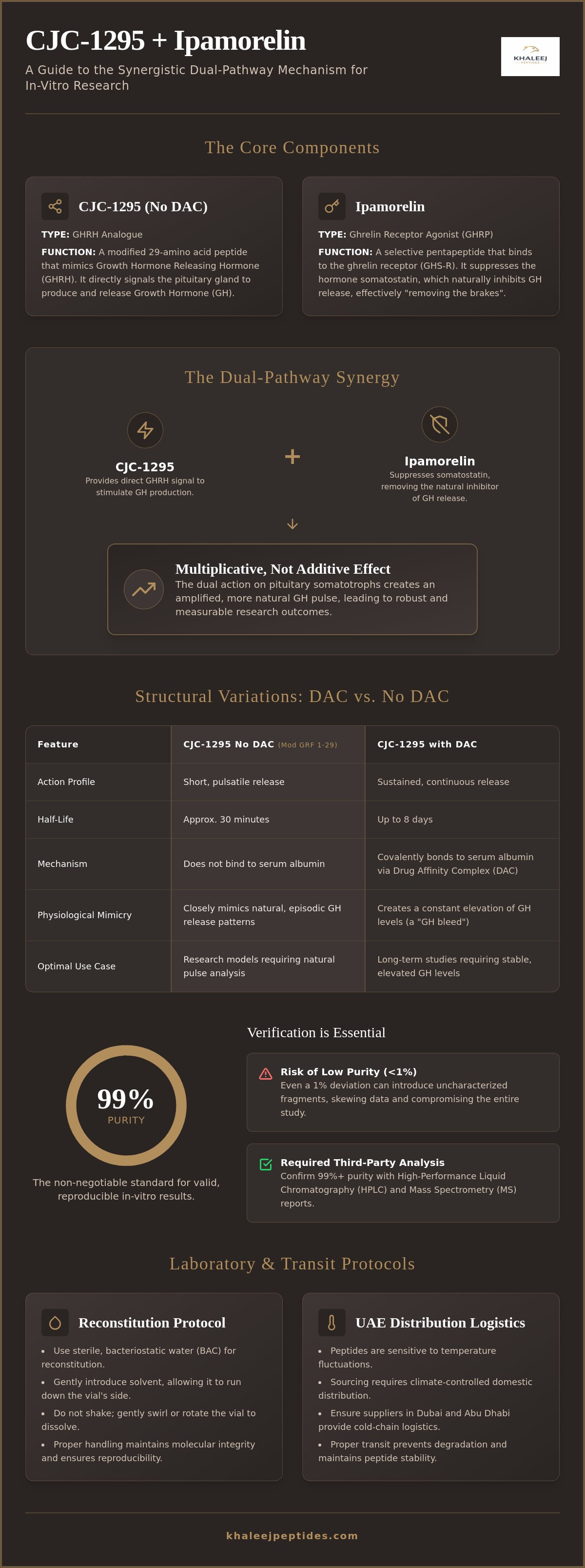
The biochemical profile of cjc 1295 ipamorelin defines a high-precision methodology for growth hormone axis research. CJC-1295 is a tetrasubstituted 30-amino acid peptide analogue of Growth Hormone Releasing Hormone (GHRH). Ipamorelin acts as a selective pentapeptide ghrelin receptor agonist. Together, they facilitate a dual-action stimulation of pituitary somatotrophs. This synergy is central to Growth hormone secretagogues research. It allows for a more comprehensive analysis of GH-axis modulation within controlled cellular environments. Precise quantification of these interactions requires materials that meet rigorous synthesis standards to ensure experimental validity.
Molecular Structure of CJC-1295 No DAC
CJC-1295 No DAC, often identified as Modified GRF 1-29, consists of the first 29 amino acids of GHRH with four specific substitutions. These modifications enhance metabolic stability and extend the half-life compared to endogenous GHRH. The absence of the Drug Affinity Complex (DAC) is a critical distinction for laboratory models. Without DAC, the peptide doesn't covalently bond to serum albumin. This results in a shorter, pulsatile action that more closely mimics natural physiological release patterns. For UAE-based laboratories, maintaining a 99% purity threshold during synthetic synthesis is paramount. Lower purity levels introduce uncharacterized peptide fragments that can skew in-vitro data and compromise the integrity of the research.
Ipamorelin as a Selective Secretagogue
Ipamorelin stands apart from earlier generations of Growth Hormone Releasing Peptides (GHRPs). While GHRP-2 and GHRP-6 often trigger secondary releases of cortisol, prolactin, or aldosterone, Ipamorelin is highly selective. It binds specifically to the growth hormone secretagogue receptor (GHS-R) in the pituitary gland. This selectivity ensures that research outcomes focus purely on GH secretion without the noise of unrelated endocrine spikes. It's a refined tool for isolating specific biological pathways. The pentapeptide structure is designed for high affinity, making it a staple in modern biochemical assays.
In laboratory settings, the combination of cjc 1295 ipamorelin leverages two distinct signaling pathways to overcome somatostatin inhibition. Somatostatin naturally limits GH release; however, the ghrelin-mimetic properties of Ipamorelin suppress this inhibitory tone. Simultaneously, the CJC-1295 component provides the direct stimulus for GH production. This dual-pathway approach ensures a robust and measurable secretagogue response in laboratory research. Proper handling of these compounds is essential to prevent degradation, especially when considering the specific climate and transit requirements for high-purity peptides within the UAE.
Synergistic Mechanisms in Growth Hormone Secretagogue Research
The efficacy of growth hormone secretagogue research relies on the interplay between distinct signaling cascades. While single-peptide models provide baseline data, the combination of cjc 1295 ipamorelin offers a more complex, representative model of physiological GH regulation. This synergy isn't merely additive; it's multiplicative. By targeting two separate receptors on the pituitary somatotrophs, researchers can observe a broader range of metabolic and regenerative markers in-vitro. This parallel stimulation creates a robust environment for analyzing how growth hormone axis modulation affects cellular behavior.
The Dual-Pathway Approach
CJC-1295 functions as a GHRH analogue, providing a direct signal to initiate GH production. However, endogenous somatostatin often acts as a physiological brake, limiting the magnitude of this response. Ipamorelin addresses this by acting as a ghrelin receptor agonist. It effectively suppresses somatostatin activity, removing the primary inhibitor of GH release. A scientific review of the safety and efficacy of these secretagogues highlights how this dual stimulation maximizes the secretory potential of the pituitary. The result is an amplified GH pulse amplitude. It doesn't just increase baseline levels; it enhances the frequency and intensity of secretion events within the laboratory model.
In research models, this heightened GH secretion leads to a measurable increase in Insulin-like Growth Factor 1 (IGF-1) expression. IGF-1 is the primary mediator of the anabolic effects associated with growth hormone. Monitoring these levels provides critical data on cellular proliferation and differentiation pathways. High-purity peptides are essential here. Contaminants can interfere with receptor binding, leading to inconsistent IGF-1 readings across test batches. For labs requiring consistent results, sourcing research-grade CJC-1295 No DAC + Ipamorelin from verified local suppliers ensures molecular stability is maintained during transit.
Applications in Metabolic and Regenerative Studies
Laboratory applications for cjc 1295 ipamorelin extend into diverse metabolic and regenerative fields. Researchers utilize these peptides to investigate cellular repair mechanisms and the kinetics of protein synthesis. In metabolic studies, the focus often shifts to adipose tissue. Specifically, researchers examine how these compounds influence lipolysis pathways and the mobilization of fatty acids. Additionally, studies on bone mineral density and collagen production rely on the stable GH/IGF-1 axis modulation provided by this synergy. These investigations provide the foundational data necessary for understanding the systemic impact of secretagogue combinations on musculoskeletal and metabolic homeostasis.
Structural Variations: CJC-1295 DAC vs. No DAC
Distinguishing between the two primary variants of CJC-1295 is essential for maintaining experimental control. The presence or absence of the Drug Affinity Complex (DAC) fundamentally changes how the peptide interacts within a biological system. A detailed history, mechanism of action, and clinical development of these secretagogues highlights the engineering behind these modifications. While both aim to stimulate the growth hormone axis, their pharmacokinetic profiles serve different research objectives. Precision in selection is the first step toward reproducible data.
Pharmacokinetics in a Research Context
The DAC variant utilizes a covalent bond to serum albumin to significantly extend the peptide’s half-life. This results in a duration of action lasting approximately 8 days. Conversely, CJC-1295 No DAC, often referred to as Modified GRF 1-29, exhibits a half-life of roughly 30 minutes. This rapid clearance is advantageous for specific laboratory models. It allows researchers to observe naturalistic, pulsatile GH release rather than constant elevation. When analyzing the cjc 1295 ipamorelin synergy, the No DAC version is typically preferred for studies focused on acute signaling responses. It provides a clearer window into the immediate feedback mechanisms of the pituitary gland. Experimental dosing in cell cultures must account for these timing differences to ensure data accuracy. Short half-lives require tighter schedules.
Selecting the Right Compound for Your Study
Choosing the correct structural variant depends on the desired GH release profile. No DAC is the standard for researchers investigating physiological-like pulses. It avoids the "GH bleed" associated with long-acting analogues where GH levels never return to baseline. Stability is a critical factor for labs operating in the UAE. The intense climate in Dubai and Abu Dhabi requires strict adherence to cold chain protocols. Peptides must be stored at consistent temperatures to prevent thermodynamic degradation. Synthesis purity is the primary safeguard against structural failure. At a 99% purity level, the cjc 1295 ipamorelin molecules are less susceptible to premature cleavage and contamination artifacts.
Specialized pen formats offer superior protection for these high-purity materials compared to traditional vials. They minimize environmental exposure during handling and reconstitution. This ensures that the structural integrity of the peptide is preserved from the point of synthesis to the final laboratory application. For UAE researchers, sourcing locally verified materials is the most effective way to mitigate the risks associated with international transit and temperature fluctuations. Precision matters in every microliter.
Handling and Reconstitution Protocols for Laboratory Peptides
Maintaining the structural integrity of cjc 1295 ipamorelin requires strict adherence to aseptic techniques and thermodynamic stability protocols. Peptide bonds are inherently fragile. Mechanical agitation or thermal fluctuations can lead to denaturation, rendering the research material inert. Laboratories must utilize a sterile environment, ideally a laminar flow hood, and professional-grade equipment for all preparation phases. High-purity synthesis is only the first step. Proper handling preserves that quality until the point of assay.
Step-by-Step Reconstitution for In-Vitro Use
Before beginning, ensure the lyophilized peptide and the diluent-either Bacteriostatic Water or sterile 0.9% NaCl-have reached room temperature for approximately 15 minutes. Sterilize the pen or vial septum using a fresh isopropyl alcohol wipe. When introducing the diluent, angle the needle so the liquid flows down the interior wall of the container. Don't spray the diluent directly onto the powder. This prevents foaming and minimizes mechanical stress on the molecular structure. Once the diluent is added, gently swirl the solution. Never shake the vial. Shaking creates air bubbles that can damage the delicate peptide chains. Gleam the solution under a lab light to ensure complete dissolution and clarity before use.
Stability and Storage Standards
Temperature sensitivity is the primary concern for UAE researchers. The local climate necessitates a continuous cold chain. Lyophilized cjc 1295 ipamorelin is stable at room temperature for short periods during transit, but long-term storage requires refrigeration between 2°C and 8°C. Once reconstituted, the solution's lifespan decreases significantly. It's best practice to use the solution within 14 to 21 days when stored under refrigeration. For studies spanning several months, consider aliquoting the reconstituted solution into smaller, single-use sterile vials to avoid repeated freeze-thaw cycles.
Protect the peptides from UV light and significant thermal fluctuations. Exposure to direct sunlight in a laboratory setting can accelerate degradation through photo-oxidation. If the solution becomes cloudy or shows visible particulates, the structural integrity has been compromised. For researchers in Dubai and Abu Dhabi, securing high-purity CJC-1295 No DAC + Ipamorelin pens designed for precise laboratory handling is the most effective way to ensure consistent dosing and molecular stability. These pens offer a protective barrier against environmental contaminants and simplify the reconstitution process for complex in-vitro models.
Procurement of High-Purity Peptides in the UAE
Sourcing high-grade materials within the Emirates requires a shift from international imports to localized, high-precision supply chains. International shipping often exposes sensitive compounds to extreme thermal stress at customs hubs and during long-haul transit. For laboratories investigating cjc 1295 ipamorelin, local procurement in Dubai ensures the cold chain remains intact from synthesis to delivery. Khaleej Peptides addresses this by maintaining domestic stock that bypasses the logistical vulnerabilities of global freight. This localized approach ensures the 99% purity achieved in the laboratory is the same purity that arrives at the research facility.
Verifying Peptide Purity for Laboratory Use
Independent verification is the cornerstone of scientific validity. Researchers shouldn't rely solely on internal manufacturer claims. High-Performance Liquid Chromatography (HPLC) and Mass Spectrometry (MS) provide the empirical data needed to confirm molecular sequence and purity. An HPLC report displays a single, sharp peak representing the target peptide; any secondary peaks indicate contaminants or synthesis by-products. Mass Spectrometry confirms the exact molecular mass of the cjc 1295 ipamorelin blend. These documents are essential for auditing experimental variables. They ensure that observed biological effects aren't the result of uncharacterized impurities or degraded peptide fragments.
Direct-to-Lab Supply in Abu Dhabi and Dubai
Reliability in the UAE research sector depends on rapid, discreet logistics. Bioscience facilities in Abu Dhabi and Dubai require materials that haven't been subjected to the 40°C+ ambient temperatures common in regional logistics hubs. Khaleej Peptides provides a specialized solution by offering fast local delivery across the Emirates. This domestic transit model utilizes temperature-controlled packaging to maintain the 2-8°C requirement for sensitive compounds. It's a critical advantage for maintaining the structural integrity discussed in previous sections regarding reconstitution and storage protocols.
Professional support for local facilities extends beyond simple delivery. Accessing research-grade materials through a UAE-based provider allows for immediate technical communication and verification of batch-specific data. Khaleej Peptides serves as a meticulous curator for the regional scientific community. By focusing on 99%+ synthesis purity and third-party testing, the provider ensures that every CJC-1295 No DAC + Ipamorelin Pen meets the rigorous standards of modern in-vitro research. This commitment to transparency and technical rigor positions the brand as a primary partner for high-level bioscience applications within the United Arab Emirates.
Advancing Biochemical Research Standards in the UAE
The dual-pathway synergy of cjc 1295 ipamorelin represents a sophisticated methodology for growth hormone secretagogue research. By integrating GHRH analogues with selective ghrelin receptor agonists, laboratories can achieve a more precise modulation of the GH axis within in-vitro models. Maintaining this precision requires an uncompromising approach to synthesis purity and handling protocols. As established throughout this review, the structural integrity of these compounds depends on verified 99% purity and a strictly managed cold chain to withstand regional environmental factors. Research validity is directly contingent upon the stability of the peptide chain from synthesis to assay.
Reliable data starts with verified materials. Ensure your laboratory models remain consistent by sourcing high-specification compounds locally to mitigate transit-related degradation. Our supply chain guarantees a 99% minimum purity threshold, supported by independent third-party HPLC verification. We provide fast local shipping across the UAE to preserve molecular stability for your bioscience facility. Precision in procurement is the first step toward excellence in laboratory research.
Order Research-Grade CJC-1295 + Ipamorelin Pens for Your UAE Laboratory
Frequently Asked Questions
What is the primary difference between CJC-1295 DAC and No DAC in research?
The primary distinction lies in the pharmacokinetic profile and half-life of the compounds. CJC-1295 DAC incorporates a Drug Affinity Complex that covalently bonds to serum albumin; this extends its duration of action to approximately 8 days. CJC-1295 No DAC exhibits a half-life of roughly 30 minutes. This shorter duration allows researchers to simulate the natural pulsatile release of growth hormone in laboratory models.
Why is Ipamorelin often paired with CJC-1295 in laboratory studies?
Pairing these compounds creates a synergistic effect that maximizes growth hormone secretagogue activity. CJC-1295 acts as a GHRH analogue to initiate production while Ipamorelin suppresses somatostatin; this is the primary inhibitor of GH release. This dual-pathway approach prevents the inhibitory brake from limiting experimental outcomes. The cjc 1295 ipamorelin combination is therefore preferred for studies requiring robust secretagogue responses.
How should CJC-1295 and Ipamorelin be stored to maintain 99% purity?
Maintain temperatures between 2°C and 8°C in a professional laboratory refrigerator to preserve molecular integrity. Lyophilized powder should remain refrigerated for long-term storage to prevent thermodynamic degradation. Once reconstituted, the solution is highly sensitive to thermal fluctuations and UV light. Consistent climate control is essential in the UAE to ensure synthesis purity remains at the 99% threshold throughout the study.
What diluent is recommended for reconstituting research-grade peptide pens?
Use Bacteriostatic Water or sterile 0.9% NaCl for the reconstitution of research-grade peptide pens. Bacteriostatic Water is often preferred for multi-use containers because it contains 0.9% benzyl alcohol; this inhibits bacterial growth. Ensure the diluent is introduced slowly along the interior wall of the vessel. This technique prevents foaming and protects the delicate peptide bonds from mechanical stress during the mixing process.
Are Khaleej Peptides products tested by third-party laboratories?
Yes, all products undergo rigorous independent verification through HPLC and Mass Spectrometry. These third-party tests confirm synthesis purity and molecular sequence accuracy before the materials are released for distribution. Khaleej Peptides provides these reports to ensure laboratory researchers have empirical evidence of the 99% purity standard. This transparency is vital for maintaining the validity of complex biochemical assays and ensuring reproducible results.
What is the expected delivery time for peptide supplies in Dubai and Abu Dhabi?
Delivery across Dubai and Abu Dhabi is executed through a fast, localized supply chain. Domestic shipping within the UAE avoids the customs delays and temperature spikes associated with international freight. Orders are handled with professional discretion and utilize climate-controlled transit to protect sensitive materials. Most researchers receive their supplies through rapid domestic courier services to ensure the cold chain is never compromised during transit.
Can these peptides be used for in-vivo or human research?
No, these peptides are strictly intended for in-vitro laboratory research and in-vitro studies. They aren't approved for human or veterinary consumption. All materials are classified for research use only and must be handled by qualified professionals in a controlled environment. Compliance with UAE regulations regarding unregistered medical products is mandatory for all laboratory procurement and handling of cjc 1295 ipamorelin.
What are the signs of peptide degradation in a reconstituted solution?
Visible cloudiness or the presence of suspended particulates indicates that the peptide has undergone denaturation or contamination. Discoloration of the solution is another primary sign of molecular degradation. If the solution loses its clear, transparent appearance, the structural integrity of the peptide bonds is likely compromised. Such solutions should be discarded immediately because they'll yield unreliable experimental data and compromise the study's integrity.